











As a critical electronic component, how exactly should you select industrial waterproof connectors? Selection cannot focus solely on ingress protection ratings—it must be evaluated from four dimensions: working environment, electrical parameters, mechanical structure, and industry compliance. Below are the six key parameters you need to confirm during selection.
1. IP Ingress Protection Rating: The First Line of Defense Against Water and Dust
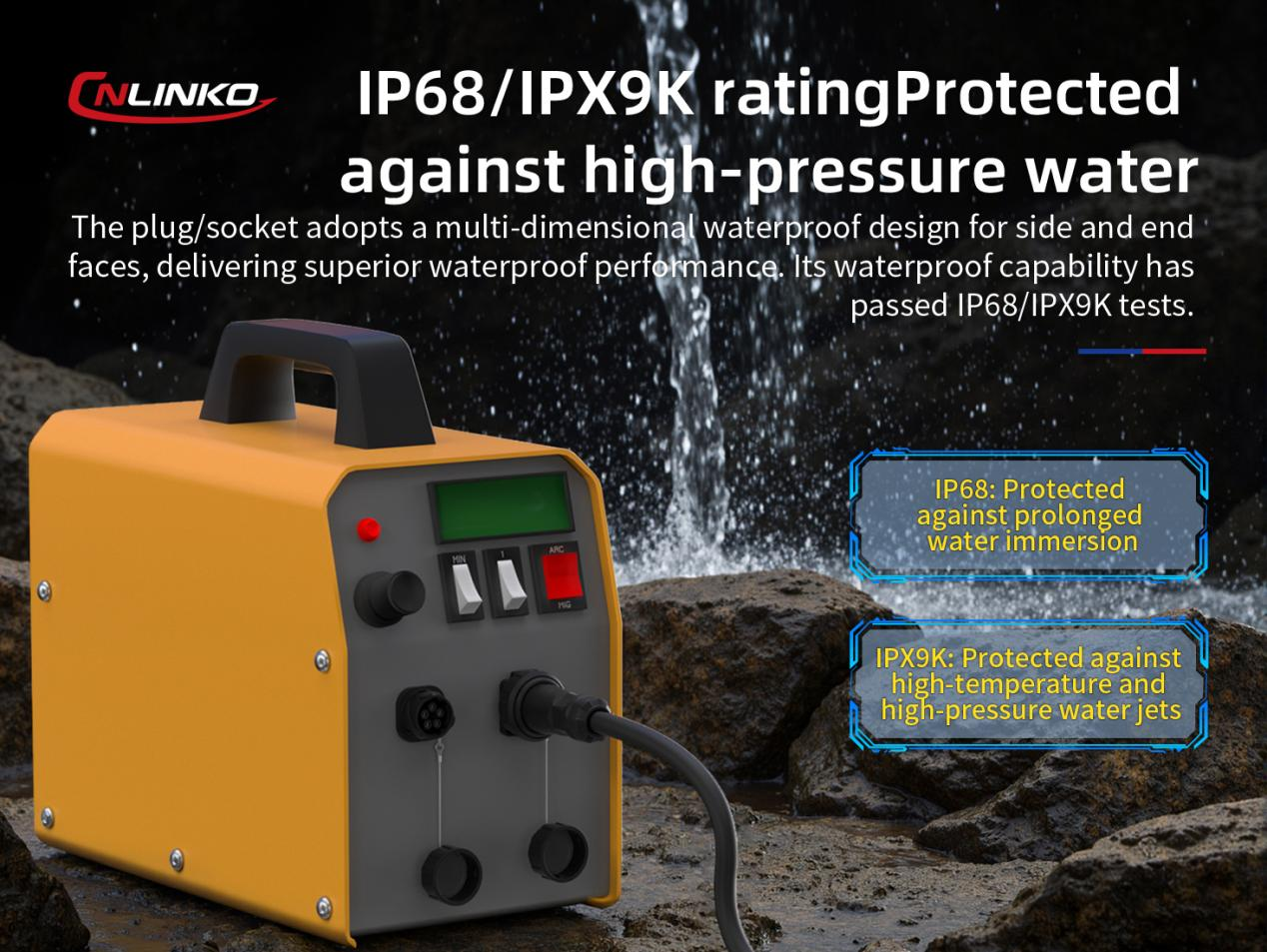
The first digit (0–6) of the IP code indicates dust protection, with 6 being completely dust-tight; the second digit (0–9K) indicates water protection. IP68 means the connector can be submerged in 1.5 meters of water for 30 minutes without failure; IPX9K withstands high-temperature, high-pressure water jets.
Don't blindly chase the highest rating—choose what fits your actual working conditions:
Energy storage cabinets, outdoor power supplies (long-term humidity or occasional submersion) →IP68
Food machinery, cleaning equipment requiring 80°C high-pressure washing → IP68 / IPX9K dual protection
Coastal areas, high salt spray, strong vibration→ metal housing for corrosion resistance and vibration resistance
When both submersion and high-pressure washing coexist, prioritize products with dual certification. For example, CNLINKO's LP16 series industrial waterproof connectors feature an "end-face + side-face" dual sealing design and meet both IP68 and IPX9K standards—a typical solution for such combined conditions.
2. Rated Current & Voltage: Match Power Requirements to Avoid Overheating and Burnout
Mismatched electrical parameters are the most common cause of connector failure. Industry rule of thumb: the device's continuous operating current should not exceed 70%–80% of the connector's rated current, leaving a safety margin for temperature rise.
Select by power level:
2–5 A: Small-signal sensors, industrial cameras (micro series)
10–25 A: Servo motors, small-scale energy storage (medium-power series)
35–100 A: Inverters, laser equipment, charging stations (high-current structures)
The higher the current-carrying capacity within the same volume, the better the temperature control. Don't design right at the rated limit—leaving a 20%–30% margin is industry consensus. CNLINKO's DL28 series, for instance, delivers 50 A in a compact package using high-conductivity copper alloy silver-plated contacts—an ideal solution for high-power, space-constrained equipment.
3. Contact Resistance: Key to Signal Integrity and Heat Control
Contact resistance directly affects transmission efficiency and temperature rise—the higher the resistance, the more heat generated. High-speed/high-frequency signal applications are especially sensitive to low contact resistance.
Two things to check when selecting:
Contact material: High-quality copper alloy as the base
Plating process: Gold or silver plating; thicker plating means better oxidation and wear resistance
CNLINKO industrial waterproof connectors use thickened gold/silver-plated contacts, with multi-pin models meeting low contact resistance standards—suitable for applications demanding stable signal transmission.
4. Mating Cycles: Durability Assurance for Frequent Connection/Disconnection Scenarios
Mating cycles refer to the number of times a connector can be mated and unmated while maintaining its electrical performance. For mobile tooling, test equipment, and daily charging/maintenance where frequent plugging/unplugging occurs, this parameter is essential.
For high-frequency mating scenarios, choose products with 2,000 cycles or more—otherwise, replacement and maintenance costs will eat away any initial savings. CNLINKO's LP16 series 90° version achieves over 2,000 mating cycles, designed specifically for frequent commissioning and mobile tooling applications.
5. Locking Mechanism: Anti-Loosening Protection Under Vibration
Different scenarios require different locking mechanisms:
Frequent plugging/unplugging for maintenance → Quick-connect coupling for easy operation
Strong vibration (on-vehicle, construction machinery, near wind turbines) → Threaded locking or anti-backoff/anti-loosening design
Both quick connection and secure locking needed → Dual-lock structure
In automotive, construction, and wind power environments, simple snap-on locks aren't enough—you need a more robust design. CNLINKO's DL28 series features a patented "bayonet coupling + anti-backoff outer ring" dual-locking mechanism, specifically engineered for high-vibration environments to prevent interface loosening and signal interruption.
6. Mounting Structure & Size: Adapting to Equipment Space
As equipment gets smaller, the connector's footprint and cable exit direction often become bottlenecks:
Narrow space with lateral moving parts→ 90°angled version to avoid cable bending damage
High-density wiring→ Compact structure with smaller volume at the same current rating
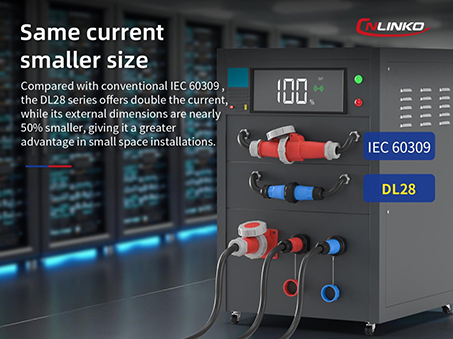
Before selecting, measure the device's mounting hole, routing path, and side clearance, then cross-check against the connector's drawing. CNLINKO's LP16/LP20 series 90° designs, along with the DL28 series which reduces volume by nearly 50% compared to traditional IEC 60309 plugs, are practical examples optimized for tight spaces.
Industrial waterproof connector selection is fundamentally part of system reliability engineering. It's not just about "is it waterproof enough?"—you need to weigh multiple factors across all dimensions.