
















When a high-current connector transmits electrical power, current flows through contact resistance and generates heat, causing the connector temperature to rise. Once the temperature rise exceeds the safe range, the service life of the connector can drop sharply, and in severe cases, it may even lead to insulation breakdown, equipment burnout, and other serious failures.
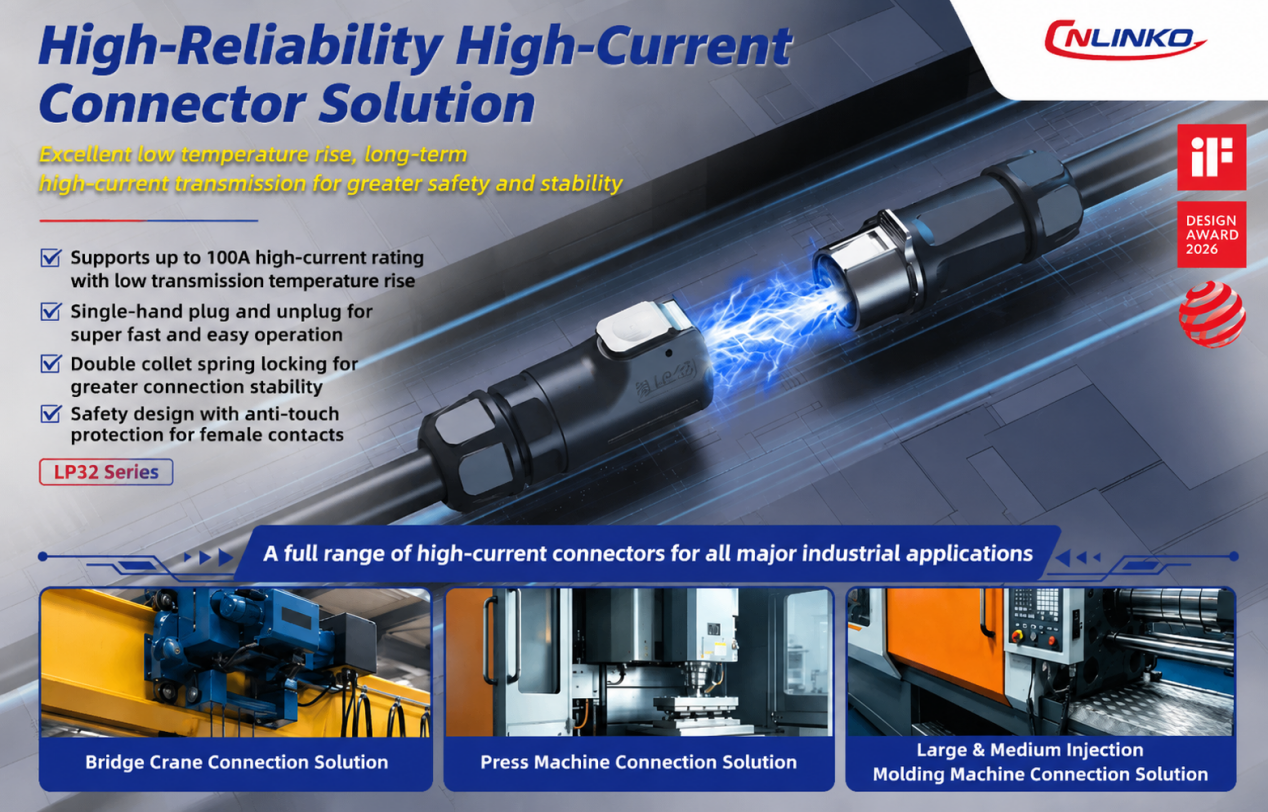
This article looks at temperature-rise control in high-current connectors from an engineering perspective, explaining where temperature rise comes from and how it can be controlled.
1. Root Cause of Excessive Temperature Rise in High-Current Connectors: Contact Resistance and Heat Buildup
According to Joule’s law, the heat-generating power of a high-current connector is:
P = I²R
When the current I is fixed, the amount of heat generated is directly proportional to the contact resistance R. The higher the contact resistance, the greater the heat generation.
Under continuous high-current operation, the oxide layer on the contact surface of a high-current connector may thicken, elastic components may experience stress relaxation, contact pressure may decrease, and contact resistance may gradually increase. As a result, temperature rise becomes more severe.
2. Five Major Consequences of Excessive Temperature Rise in High-Current Connectors
Sharp decline in service life: High temperatures accelerate insulation material aging and weaken the elasticity of contact components, significantly shortening the service life of high-current connectors.
Major safety risks: Excessive temperature rise may ignite the housing or greatly increase the risk of insulation breakdown, which is especially dangerous in unattended operating environments.
Impact on equipment and systems: Local overheating can transfer heat to cables and nearby components, accelerating the aging of the entire system.
Worsening failure loop: High temperatures can cause terminal stress relaxation and reduced contact force, which further increases contact resistance and creates a self-reinforcing failure cycle.
High downtime costs: Unplanned shutdowns caused by overheated high-current connectors can result in losses far greater than the value of the connector itself.
3. Key Design Factors for Low Temperature Rise in High-Current Connectors
(1). Contact Material: High Conductivity Is the Foundation
The most direct way to reduce contact resistance is to use highly conductive materials. Common optimization approaches include:
Copper alloy base material: High-performance copper alloys offer good electrical conductivity and elasticity, helping maintain reliable contact performance even after repeated mating cycles.
Surface plating treatment: Silver or gold plating can reduce surface contact resistance and slow oxidation at the contact interface. Taking a 100A high-current connector solution with 3 contacts as an example, high-conductivity copper alloy combined with silver plating can control contact resistance at around 0.3 mΩ, reducing heat generation from the source.
(2). Locking Structure: Maintaining Long-Term Stable Contact Pressure
Insufficient contact pressure in a high-current connector can lead to unstable contact and increased resistance. Excessive pressure, however, may accelerate material creep and wear. Proper contact stress is critical to maintaining low temperature rise.
A dual-arm spring locking structure has become an effective design approach in recent years. Its locking force can reach twice that of a traditional single-arm spring. Even under high-frequency vibration and frequent start-stop operating conditions, it helps maintain stable contact and effectively prevents contact resistance from surging due to vibration-induced loosening.
(3). Heat Dissipation Design and Insulation Materials
The heat deflection temperature of the plastic housing directly affects structural integrity under high-temperature conditions. Common materials include PBT and flame-retardant PC. Material selection should be based on actual temperature-rise requirements.
In addition, properly increasing terminal spacing and adding ventilation openings in key areas of the housing can help improve heat dissipation and reduce heat buildup.
(4). IP Protection and Sealing Design
Ingress of moisture and corrosive substances can accelerate contact oxidation, causing contact resistance to rise. High-level protection, such as IP68/IPX9K, can effectively block external corrosion and help ensure long-term low-temperature-rise stability.
If the housing material also has f1-rated UV resistance certification and has passed salt spray testing, it can better adapt to harsh outdoor environments.
4. CNLINKO High-Current Connection Solutions: Engineering Practice for Low Temperature Rise
CNLINKO has developed a complete product portfolio for high-current connectors across a wide range of application scenarios. Among them, the LP32 Series high-current connector supports 100A ultra-high-current transmission and delivers excellent temperature-rise performance.
Core low-temperature-rise technologies include:
High-conductivity copper alloy + silver-plated contacts: Contact resistance can be reduced to 0.3 mΩ for 3-contact products.
Dual-arm spring locking structure: The locking force is twice that of a traditional single-arm design, providing excellent vibration resistance and preventing contact resistance from surging due to vibration-induced loosening.
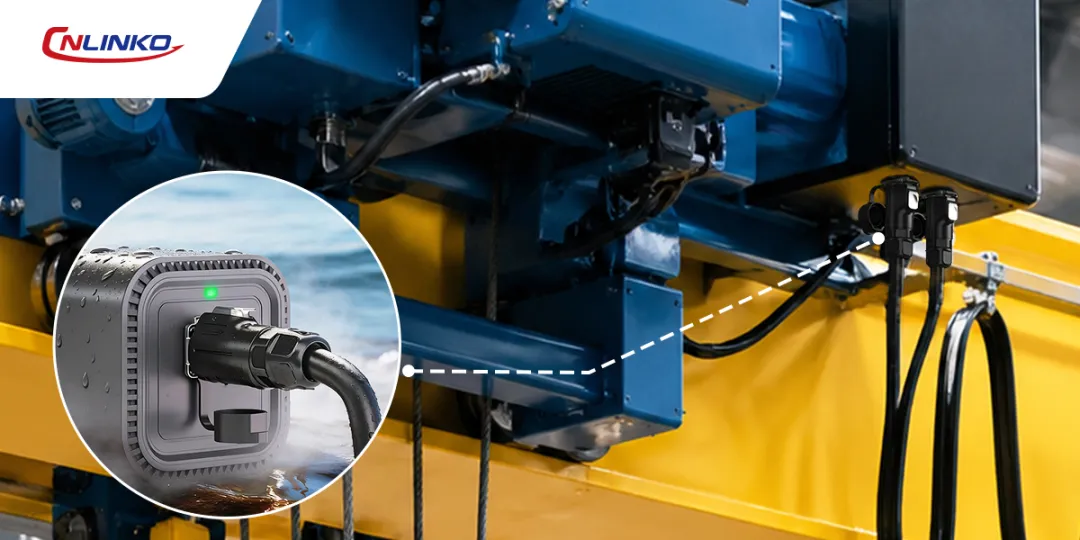
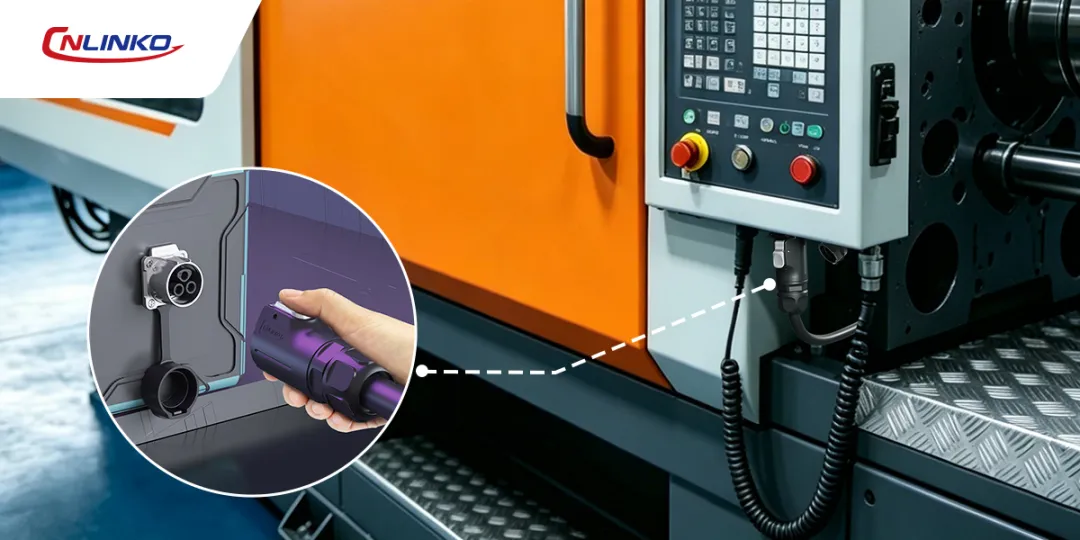
Measured temperature rise ≤55K: In long-duration continuous operating scenarios such as bridge cranes, press machines, and large- and medium-sized injection molding machines, this solution keeps temperature rise strictly within 55K. Combined with IP68/IPX9K protection, it enables practical engineering implementation of “long-term high-current transmission with sustained low temperature rise.”
5. Summary
Preventing excessive temperature rise in high-current connectors depends on a closed loop across three levels: contact resistance and material matching at the selection stage, locking structure and thermal design optimization at the design stage, and measured temperature-rise data plus protection rating at the validation stage.
When contact resistance is low enough, locking is reliable enough, and protection is robust enough, the risk of excessive temperature rise can be eliminated from the source.