

















When sourcing industrial waterproof connectors, start with three questions: Where will the equipment be sold? What documents does the project require? Is the selected model covered by those documents? UL, TÜV, and CQC are common certification references in procurement. CE is a conformity marking under applicable EU legislation. RoHS and REACH address restrictions on hazardous substances and chemical compliance, respectively. These documents are not interchangeable, and certification marks alone do not show whether a connector meets the project's water ingress protection requirements.
CNLINKO helps customers match connector models, certification and compliance documents, and ingress protection test conditions to their target market, equipment application, and project specifications. This supports sample selection, bill of materials (BOM) review, and preparation of documentation for end-product certification.
I. What Certification and Compliance Documents Mean and What Buyers Should Check
01. UL: A Common Basis for Safety Evaluation in North American Industrial Projects
What does UL mean? UL Component Recognition means the industrial connector has been evaluated against applicable safety requirements for use in an end product under specified conditions. UL Recognized is not the same as UL Listed, and it does not mean the end product that incorporates the connector has passed a UL evaluation.
What should buyers check? Verify the UL file number, certification category, full model number, ratings, and conditions of use. Confirm whether the documentation covers the United States, Canada, or both.
02. TÜV: Third-Party Certification Commonly Referenced in European Industrial Projects
What does TÜV mean? For industrial equipment intended for Europe, a TÜV certificate can provide third-party evidence for product selection, supplier review, and project acceptance. It indicates that the listed connector models or configurations meet the cited standards and certification requirements. It is not equivalent to CE marking and does not replace the applicable EU conformity assessment for the end product.
What should buyers check? Determine whether the European customer or project specification calls for TÜV certification, a particular issuing body, or a specific standard. Then verify the certificate number, validity, and annexes to ensure the full model number, pin count, and ratings are covered.
03. CQC: Voluntary Product Certification for Projects in China
What does CQC mean? CQC Mark certification indicates that the product meets the relevant certification rules. It can serve as supporting evidence for procurement or supplier reviews in China. It is voluntary and is not the same as China Compulsory Certification (CCC).
What should buyers check? Determine whether the bid documents, customer requirements, or project specifications call for CQC or CCC. Then verify the certificate status, applicable standards, and full model number.
04. CE: Product Conformity Marking for the EU Market
What does CE mean? For products subject to CE marking requirements, the mark indicates that the manufacturer has completed the applicable conformity assessment and takes responsibility for compliance with applicable EU legislation. Connector documentation may be included in the technical documentation for the end product, but it does not replace the end product's own conformity assessment.
What should buyers check? First determine whether the connector itself is subject to CE marking requirements. If so, verify the manufacturer, model number, and applicable legislation in the EU Declaration of Conformity (DoC), rather than relying on the CE mark on the product or packaging alone.
05. RoHS: Restrictions on Hazardous Substances in Electrical and Electronic Equipment
What does RoHS mean? The EU RoHS Directive restricts the use of certain substances in electrical and electronic equipment within its scope, including lead, cadmium, hexavalent chromium, and certain flame retardants and plasticizers. Supplier documentation can help end-product manufacturers assess material compliance for the components they use.
What should buyers check? Verify the legislation cited, the document date, and the scope of the compliance declaration or supporting test documentation. If purchasing a finished cable assembly, confirm that the documentation covers the configuration being supplied, not just the standalone connector.
06. REACH: Chemical Restrictions and Supply Chain Information Requirements
What does REACH mean? In industrial connector procurement, REACH documentation is used to determine whether the product contains substances of very high concern (SVHCs) on the Candidate List and whether it meets applicable substance restrictions. REACH addresses chemical compliance, not electrical safety certification.
What should buyers check? Verify the declaration date, the version of the SVHC Candidate List referenced, the applicable substance restrictions, and whether the documents cover the specific connector model or cable assembly being purchased.
Verify ingress protection separately. If the project calls for IP68 or IPX9K, review the test documentation for the specific model and confirm the test conditions and assembly state. For IP68, for example, check the immersion depth and duration. If connectors may be disconnected during maintenance or transportation, verify whether there is separate test evidence for the unmated condition or the condition with a protective cap installed.
II. How CNLINKO Supports Product Selection and Certification Review
01. CNLINKO Matches Certification and Compliance Documents to Specific Models
For projects in China, North America, and Europe, CNLINKO can provide UL, TÜV, and CQC certification documentation, along with applicable CE, RoHS, and REACH compliance documents, depending on the connector series, model, and configuration. During sample selection, customers can provide the equipment application and project specifications so CNLINKO can help identify candidate models and verify the pin counts, ratings and conditions of use covered by the documentation.
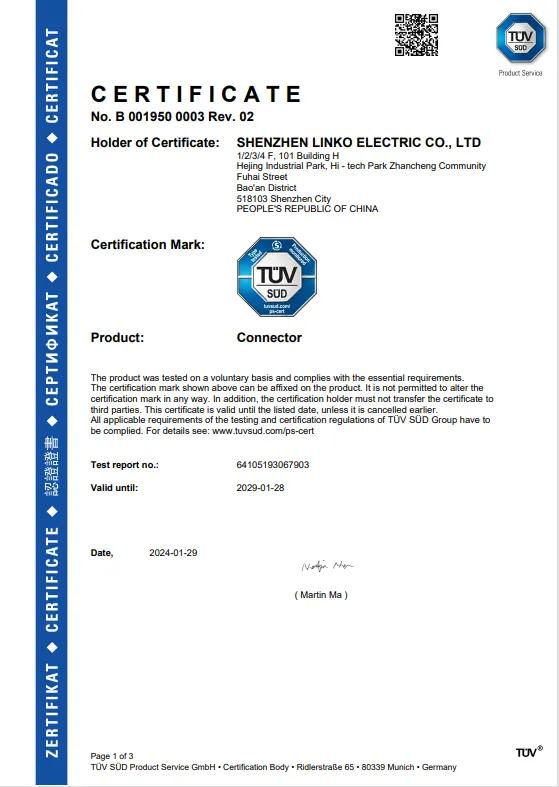
For example, buyers can check the applicable 2- and 3-pin LP28 Series industrial connector models against the TÜV certificate.
02. CNLINKO Supports Performance Verification with UL- and TÜV-Authorized Witness Testing Labs
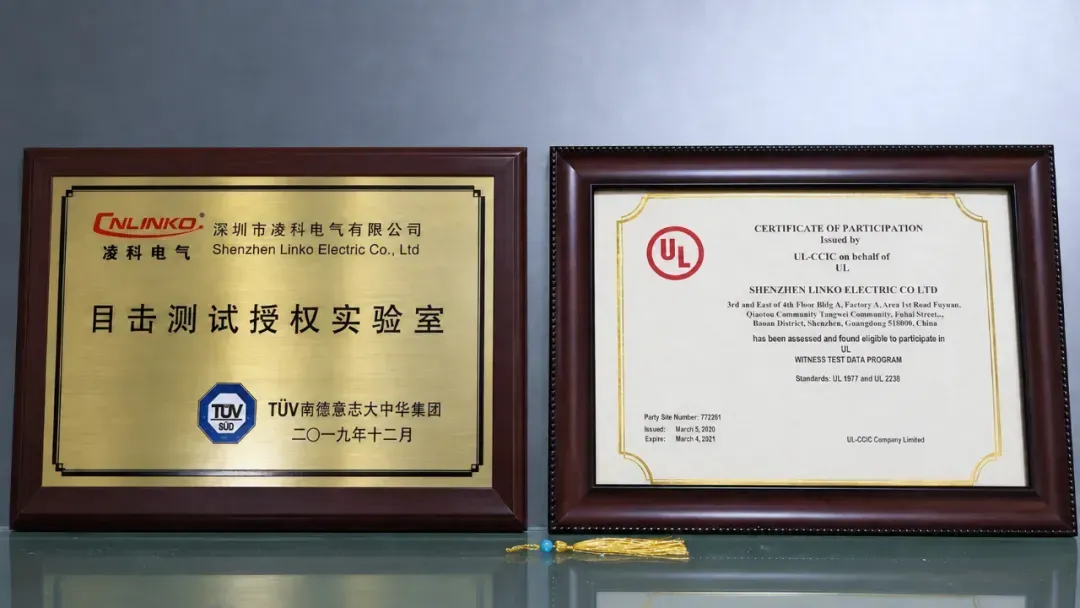
CNLINKO operates UL- and TÜV-authorized witness testing laboratories and has electrical, mechanical, and environmental reliability testing capabilities. These include dielectric withstand, insulation resistance, contact resistance, temperature rise, mating cycle endurance, vibration and shock, and dust and water ingress testing.
For procurement and engineering teams, a certificate shows whether the model falls within the certification scope, while test documentation shows the conditions under which the product achieved the stated performance. For outdoor equipment, check the ingress protection tests and assembly state. For power connections, review the ratings and temperature rise test conditions. Witness testing is limited to the laboratory's authorized scope, and performance should be verified against the test documentation for the specific model.
03. CNLINKO Supplies Connectors, Cable Assemblies, and Compliance Documents for End-Product Review
CNLINKO supplies power, signal, data, and hybrid connectors, along with matching cable assemblies. For end-product safety evaluations, customer factory audits, or project bids, CNLINKO can provide applicable specifications, dimensional drawings, certificates, compliance declarations, and supporting test documentation for the selected model.
Customers can use the same BOM to cross-check connector models, cable specifications, termination methods, electrical ratings, and supporting documents. This reduces the need to reconcile discrepancies between samples, submission documents, and the configuration actually supplied.
III. Frequently Asked Questions About Industrial Waterproof Connector Procurement
01. Do industrial waterproof connectors for equipment exported to Europe need a TÜV certificate?
Not necessarily. First identify the EU legislation and conformity assessment requirements that apply to the end product. Then check whether the customer, bid documents, or project specifications call for a TÜV certificate. A TÜV certificate can serve as third-party evidence, but it is not a universal requirement for European projects.
02. Does using a UL Recognized connector mean the end product will pass a UL evaluation?
Not necessarily. UL Component Recognition can support an end-product evaluation, but the connector's intended use, ratings, and installation in the end product must still be checked against its conditions of acceptability.
03. Does the original certificate still apply if the pin count, termination method, or cable changes within the same series?
It depends on whether the full model number and revised configuration are still covered by the certificate and its annexes. If cable specifications or assembly methods change, also confirm whether the original ingress protection test results apply to the new configuration.
04. If an industrial waterproof connector has UL or TÜV certification, do buyers still need to check IP68 or IPX9K test documentation?
Yes. Verify that test evidence covers the project's required ingress protection rating and conditions of use. Do not rely on the UL or TÜV mark alone. If the certificate or its annexes do not specify the relevant details, request the ingress protection test documentation for the exact model. For IP68, check immersion depth, duration, and assembly state. For IPX9K, check the high-temperature, high-pressure water jet test conditions. If the connector will be disconnected during maintenance, verify whether test evidence covers the unmated or capped condition.
05. What information does CNLINKO need to provide certification and compliance documentation?
If the model has been selected, provide the full model number, the configuration to be supplied, the target market, and any customer-specified certification requirements. If no model has been selected, provide the equipment application, rated current and voltage, pin count, required ingress protection rating, and termination method. CNLINKO can use this information to identify candidate models and confirm which certificates, compliance declarations, and test documents are available.
Equipment manufacturers sourcing industrial waterproof connectors for domestic or export markets can submit their project requirements or BOM to CNLINKO. CNLINKO can help verify product configurations, certification coverage, and ingress protection test conditions so customers can identify which requirements are documented and which still need verification before sample approval.