





















The locking method of an industrial waterproof connector affects installation speed, mechanical retention, serviceability, and required operating space. Quick-lock, bayonet, and threaded connectors can all provide a reliable plug-to-receptacle connection, but they use different locking principles and operating methods.
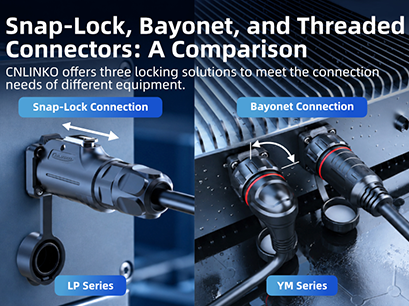
In brief:
① Quick-lock connectors use push-to-lock and press-to-release operation. They are fast and well suited to frequent disconnection and high-volume assembly.
② Bayonet connectors lock through insertion followed by a short rotation, balancing operating speed and mechanical retention.
③ Threaded connectors lock through multiple turns. Their engagement state is clear, making them suitable for fixed interfaces that are rarely disconnected.
CNLINKO offers quick-lock, bayonet, and threaded industrial waterproof connector solutions for different equipment requirements. Final selection should still be based on operating conditions, installation space, service frequency, and the technical data for the exact model.
I. What Is the Difference Between Quick-Lock, Bayonet, and Threaded Industrial Waterproof Connectors?
omparison of Three Industrial Connector Locking Methods Operation, Maintenance Efficiency, and Application Requirements of Quick-Lock, Bayonet, and Threaded Connectors
| Comparison | Quick-Lock Connectors | Bayonet Connectors | Threaded Connectors |
|---|---|---|---|
| Locking Method | Push-to-lock | Insert, then rotate briefly | Multi-turn threaded coupling |
| Release Method | Press release mechanism, then pull out | Rotate in reverse, then pull out | Rotate coupling nut in reverse |
| Operating Speed | Fast | Relatively fast | Relatively slow |
| Locking Characteristics | Fewer steps; high connection efficiency | Balances operating efficiency and mechanical retention | Clear engagement status; stable connection retention |
| Operating Clearance | Requires axial mating and release clearance | Requires clearance for short-angle rotation | Requires clearance for continuous rotation |
| Maintenance Characteristics | Suitable for frequent disconnection and volume assembly | Suitable for periodic disconnection | Better for connections requiring infrequent reconnect |
| Application Characteristics | Fast installation, frequent maintenance, easy operation | Balances connection stability and disconnection efficiency | Compact interfaces, fixed connections, low maintenance frequency |
1. Quick-Lock Connectors: Push to Lock, Press to Release
Quick-lock industrial waterproof connectors eliminate repeated rotation. Once the plug is aligned and fully inserted into the receptacle, the locking mechanism automatically provides mechanical retention. To disconnect, press the release and remove the plug.
This design generally enables tool-free connection and disconnection, improving efficiency in volume assembly, commissioning, and field maintenance.
Key characteristics include:
- Fewer connection and disconnection steps;
- Primarily requires axial insertion and release clearance;
- Convenient for module replacement and frequent maintenance;
- Suitable for high-volume equipment with multiple interfaces.
2. Bayonet Connectors: Short Rotation with Efficient Mechanical Locking
Bayonet industrial waterproof connectors normally lock with a short rotation after the plug is fully inserted. Compared with a multi-turn threaded design, they reduce operating time while maintaining mechanical retention.
Confirm that the bayonet is fully rotated into position. Incomplete locking may reduce connection retention and sustained compression of the sealing structure.
Key characteristics include:
- Operating speed between quick-lock and threaded designs;
- Requires clearance for a short rotation;
- Balances periodic disconnection with mechanical retention;
- Different housing materials can support different operating conditions.
3. Threaded Connectors: Multi-Turn Engagement with a Clear Locking State
Threaded industrial waterproof connectors generate axial retention through continuous engagement between the coupling sleeve and receptacle threads. Installation normally requires aligning the keying features before tightening the sleeve to the specified position.
Thread engagement and the final locking state are easy to verify. This design suits interfaces that are rarely disconnected, but it requires enough space to rotate the coupling sleeve continuously.
Avoid angled insertion, cross-threading, or forced tightening, which may damage the threads and affect mating, locking, and sealing.
No locking method is universally superior. Selection should also account for equipment vibration, cable pull, installation space, service frequency, and environmental protection requirements.
II. How to Choose Among the Three Locking Methods
1. Select by Service Frequency
For frequent commissioning, calibration, module replacement, or high-volume assembly, prioritize quick-lock industrial waterproof connectors.
For periodic disconnection where both speed and mechanical retention matter, consider bayonet industrial waterproof connectors.
For connections that remain installed and are disconnected only during service or overhaul, threaded industrial waterproof connectors may be more suitable.
2. Select by Mechanical Conditions
Where vibration, shock, or cable pull is present, verify:
- Whether the locking mechanism has a defined mechanical stop;
- Whether vibration can cause the lock to back off;
- Whether the housing can withstand the expected impact and external force;
- Whether vibration, mechanical shock, and transient interruption test data are available;
- Whether cable retention and strain relief meet the application requirements.
Vibration resistance cannot be determined from the terms “quick-lock,” “bayonet,” or “threaded” alone. It also depends on the specific design, materials, manufacturing quality, installation condition, and test parameters.
3. Select by Available Operating Space
Quick-lock connectors mainly require axial insertion and release clearance. Bayonet connectors require space for a short rotation, while threaded connectors require room to rotate the coupling sleeve continuously.
Do not compare connector body dimensions alone. Also consider interface spacing, cable bend direction, panel thickness, and the technician’s actual access path. For dense or obstructed installations, conduct a sample fit check first.
4. Select by Environmental Protection Requirements
The locking method alone does not define the protection of an industrial waterproof connector. Models with the same locking structure may have different IP ratings, sealing configurations, and applicable states.
Before purchase, verify the exact model’s protection rating, test standard, test conditions, mated state, compatible cable, and installation requirements. Waterproof performance should not be inferred from appearance or locking type alone.
III. What Distinguishes CNLINKO’s Three Industrial Waterproof Connector Solutions?
To address different requirements for interface size, connection speed, structural strength, environmental suitability, and service frequency, CNLINKO offers quick-lock, bayonet, and threaded industrial waterproof connectors.
Each design emphasizes fast servicing, corrosion resistance, mechanical protection, or compact installation. Project selection should be based on the complete part number, datasheet, certifications, and test documentation.
1. Quick-Lock Solutions: LP and BD Series Industrial Waterproof Connectors
CNLINKO LP Series and BD Series industrial waterproof connectors use quick-lock designs that eliminate multi-turn operation and improve connection efficiency during assembly, commissioning, and maintenance.
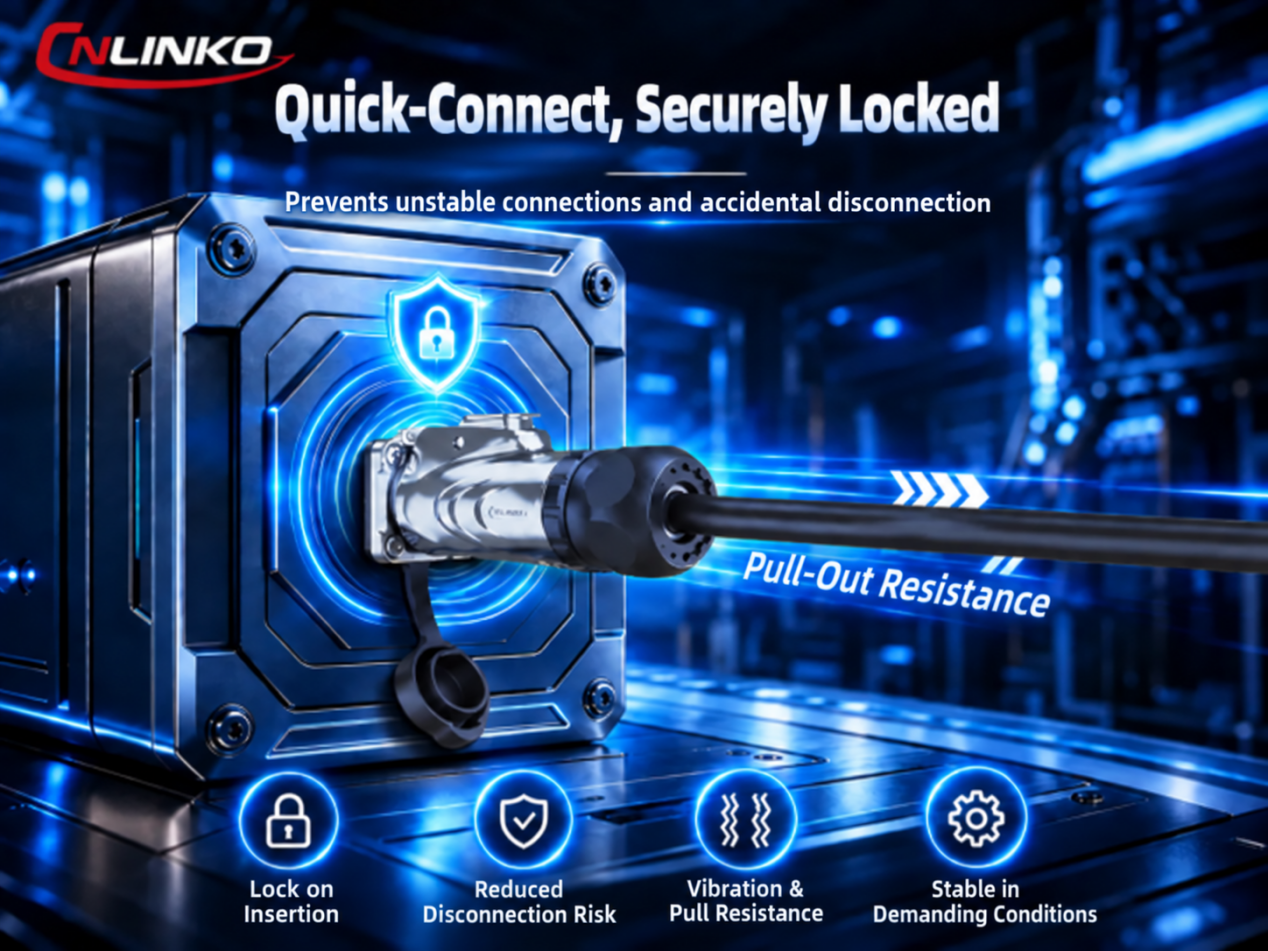
The two series position the quick-lock mechanism differently and target different design priorities, supporting conventional quick connection and compact panel installation.
LP Series industrial waterproof connectors use a patented “push to lock, press to release” mechanism. Once fully inserted, the plug locks in place; pressing the release disconnects it. Connection and disconnection are fast and tool-free.
The series is suitable for high-volume assembly, commissioning, module replacement, and frequent maintenance.
BD Series industrial waterproof connectors combine a receptacle-side quick-lock mechanism with a recessed installation design. Once the plug is fully inserted, a spring mechanism in the receptacle locks the connection.
The recessed receptacle reduces external panel space and supports compact interface layouts, making it suitable for dense panels, space-constrained equipment, and frequent mating.
2. Bayonet Solutions: YM and DH Series Industrial Waterproof Connectors
CNLINKO YM Series and DH Series industrial waterproof connectors use a helical bayonet locking mechanism.
After the plug and receptacle are aligned and fully mated, a short rotation completes the lock. Compared with multi-turn threaded coupling, the bayonet design reduces rotation while balancing service speed and mechanical retention.
YM Series industrial waterproof connectors use an all-plastic housing that combines low weight with corrosion resistance. They suit applications that prioritize equipment weight reduction, environmental durability, and efficient periodic maintenance.
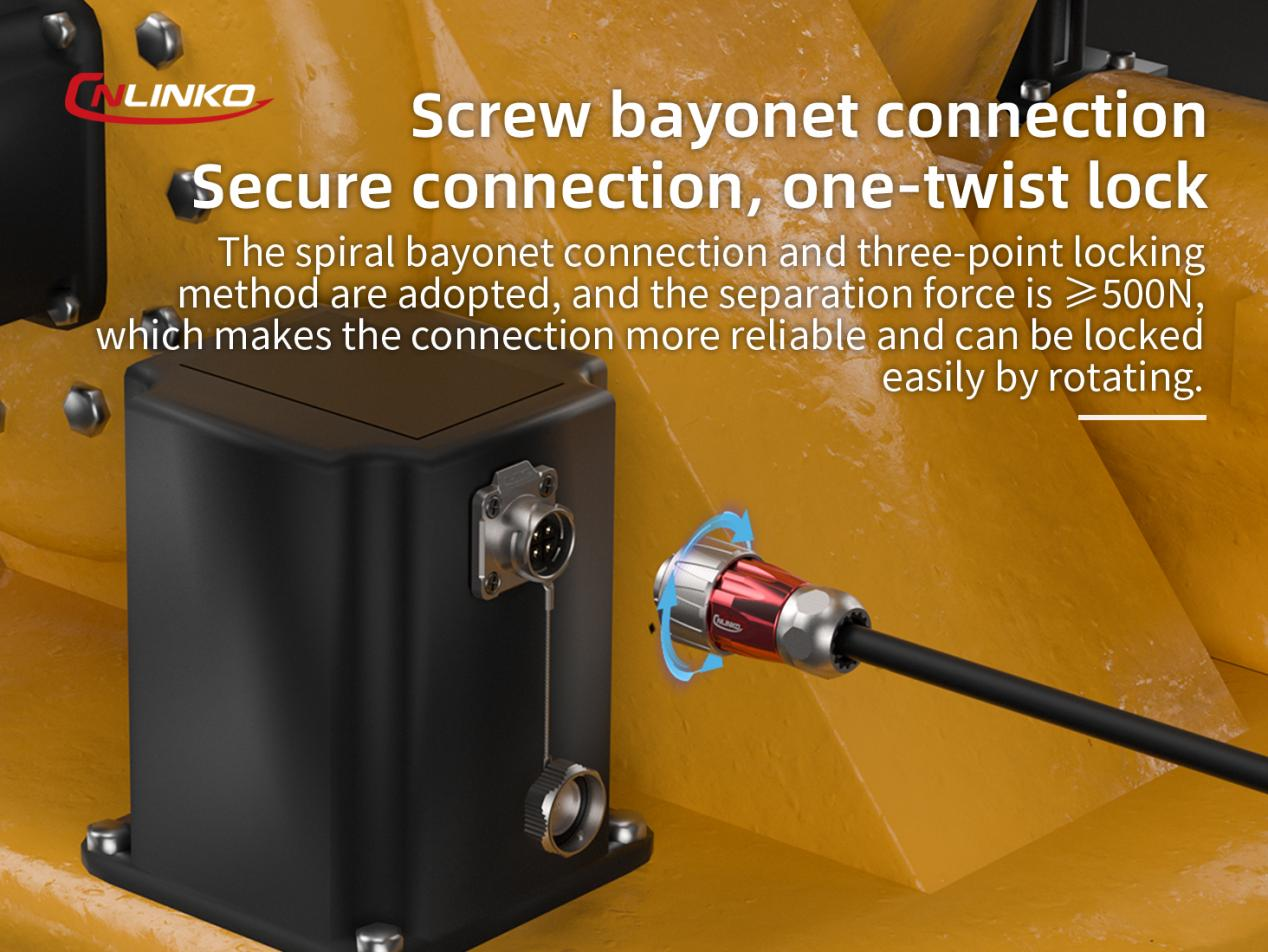
DH Series industrial waterproof connectors use an all-metal housing to improve impact and deformation resistance. They are better suited to industrial conditions involving vibration, shock, collision, or frequent handling.
3. Threaded Solution: LM12 Series Industrial Waterproof Connectors
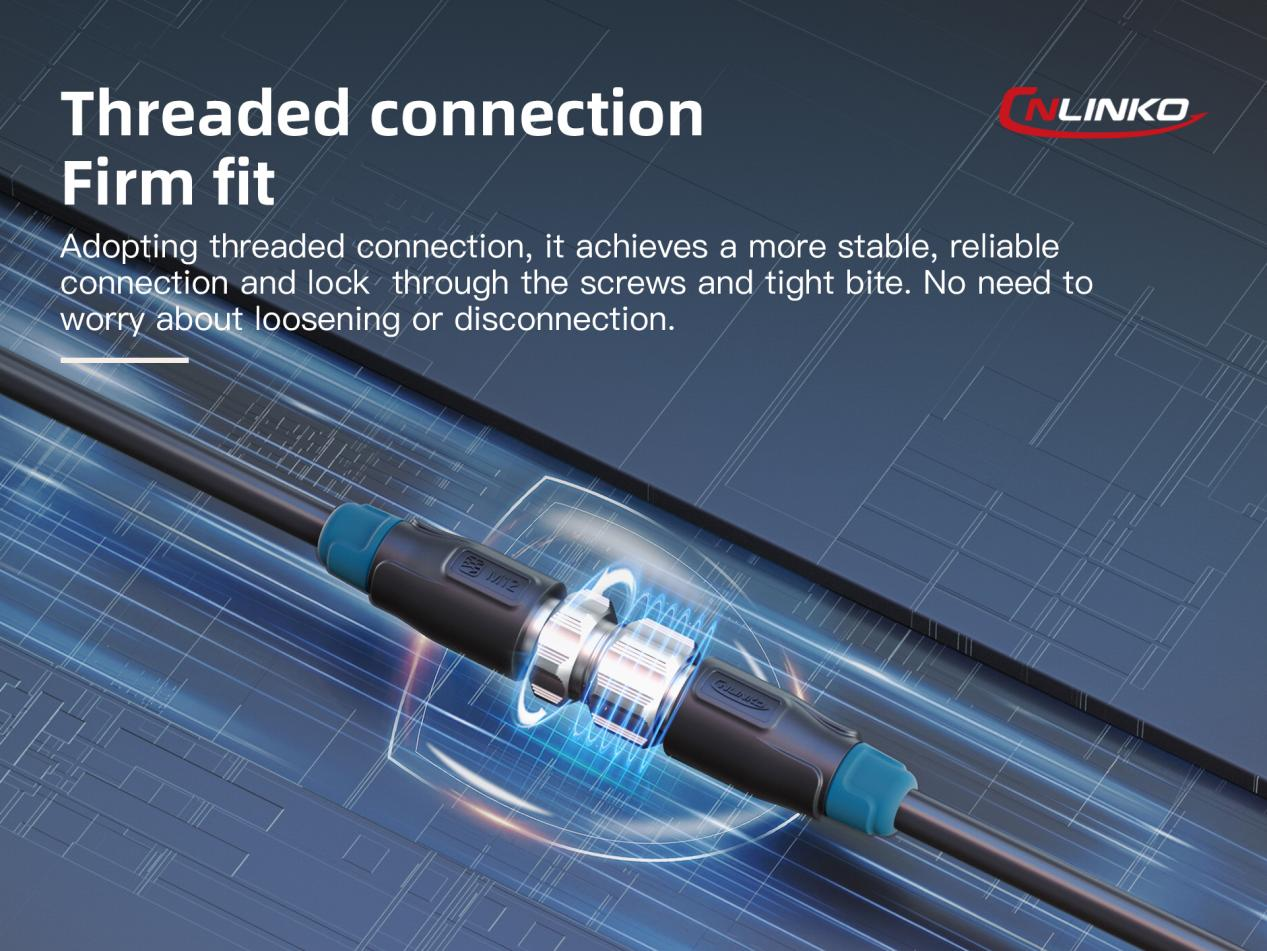
CNLINKO LM12 Series industrial waterproof connectors use a threaded locking design. Rotating the coupling sleeve progressively engages the plug and receptacle and retains the connection.
The series features a compact interface and a clear engagement state, meeting the needs of small industrial equipment with limited installation space and fixed connections.
LM12 Series industrial waterproof connectors may be considered for compact, multi-pin equipment interfaces that are rarely disconnected or where thread engagement is used to confirm the locked state.
CNLINKO Locking Solutions Comparison Structural Features and Application Needs of LP, BD, YM, DH, and LM12 Series Connectors
| CNLINKO Solution | Locking Mechanism | Key Features | Best-Suited Requirements |
|---|---|---|---|
| LP Series Quick-Lock Connectors | Push-to-lock, press-to-release | One-hand quick connection, tool-free operation | Volume assembly, frequent maintenance, high disconnection efficiency |
| BD Series Quick-Lock Connectors | Receptacle-side quick-lock mechanism | Redesigned design saves space; plug and use | Dense interfaces, limited panel space, frequent mating |
| YM Series Bayonet Connectors | Helical bayonet locking | All-plastic housing; lightweight, corrosion-resistant, environmentally adaptable | Equipment weight reduction, corrosion resistance, periodic maintenance |
| DH Series Bayonet Connectors | Helical bayonet locking | All-metal housing; high mechanical strength, vibration and impact resistance | Complex mechanical conditions, including vibration, impact, and collision |
| LM12 Series Threaded Connectors | Multi-turn threaded coupling | Compact interface; stable connection retention | Limited installation space, infrequent disconnection, fixed connections |
IV. What Else Should Be Verified Before Purchasing Industrial Waterproof Connectors?
Regardless of locking method, verify the following for the complete part number before purchase:
- Rated current, rated voltage, and contact count;
- Compatible conductor size and cable outer diameter;
- Pin assignment, transmission type, and shielding requirements;
- Termination method and installation instructions;
- Panel cutout dimensions and interface spacing;
- IP rating and corresponding test conditions;
- Mating life, vibration, and mechanical shock data;
- Product certifications and compliance documentation;
- Sample availability, cable assembly support, and volume supply capability.
For power, signal, Industrial Ethernet, or high-speed data interfaces, also confirm that temperature rise, contact resistance, impedance, shielding, and bandwidth meet the equipment requirements. A secure lock alone does not guarantee electrical or transmission compatibility.
V. Frequently Asked Questions
Are Quick-Lock Industrial Waterproof Connectors Always Better Than Threaded Types?
No. Quick-lock designs require fewer steps and suit frequent disconnection. Threaded designs provide a clear engagement state and are better suited to interfaces that are rarely disconnected. Choose based on service method, mechanical conditions, and available space.
Are Bayonet Industrial Waterproof Connectors Suitable for Vibrating Equipment?
Bayonet designs can balance operating efficiency and mechanical locking, but vibration resistance still depends on mechanical stops, housing strength, assembly condition, and test results. It cannot be determined from the term “bayonet” alone.
Do Connectors with the Same Locking Method Have the Same Waterproof Performance?
No. Protection also depends on sealing design, cable outer diameter, mated state, termination method, and installation quality. Review the test conditions for the exact model.
Can the Same Specifications Be Applied to Different Pin Counts Within One Series?
No. Different pin counts, contacts, cables, and sealing configurations may have different ratings and protection conditions. Use the documentation for the complete part number.
The key differences among quick-lock, bayonet, and threaded industrial waterproof connectors are their locking principles, operating steps, and maintenance efficiency.
Quick-lock connectors improve high-volume assembly and frequent maintenance through push-to-lock and press-to-release operation. Bayonet connectors balance connection speed and mechanical locking. Threaded connectors emphasize a clear engagement state and stable retention.
CNLINKO offers all three industrial waterproof connector types, enabling differentiated selection based on service frequency, mechanical conditions, installation space, and environmental protection needs. Final selection should match exact-model data and test documentation to the equipment conditions and be confirmed through sample installation testing.