
















In critical fields such as new energy vehicles, industrial robots, and data centers, high-current connectors play the role of the "heart" of power transmission. Improper selection can not only reduce system efficiency but also lead to safety hazards like overheating or even fire. Therefore, engineers must establish a rigorous methodology and comprehensively evaluate core parameters when selecting high-current connectors.

I. Electrical Parameters: The Top Priority in High-Current Connector Selection
The primary task in selecting a high-current connector is determining the electrical parameters. Rated current is fundamental, but it should never be taken at face value. To ensure electrical safety, the actual operating current should generally not exceed 80% of the rated value. In high-reliability applications, it is recommended to choose a connector with a rated current of 1.5 to 2 times the maximum working current to handle transient overloads. Additionally, the contact resistance of high-current connectors should be as low as possible; excessive contact resistance leads to localized heating.
II. Environmental Adaptability: Key to Long-Term Reliability of High-Current Connectors
Environmental adaptability is crucial for ensuring long-term reliability of high-current connectors. Different scenarios impose different requirements on the ingress protection (IP code) level of the connector. In industrial automation and outdoor equipment, high-current connectors typically need to meet IP67, IP68, or even IPX9K protection ratings. At the same time, the operating temperature range of the connector must match the working conditions. In enclosed cabinets or high-temperature environments, care must be taken to ensure that temperature rise does not exceed allowable limits.
III. Mechanical Requirements: Ensuring Connection Stability of High-Current Connectors
Mechanical requirements directly affect the stability and maintenance convenience of high-current connectors. During selection, the mating cycle life should match the equipment maintenance frequency. For test equipment requiring frequent plugging/unplugging, connectors with gold-plated contacts and higher cycle life should be chosen; for fixed equipment, other contact platings may suffice. In environments with vibration risks, connectors with robust locking mechanisms must be selected to prevent accidental disconnection.
IV. Termination and Installation: Details That Cannot Be Overlooked in High-Current Connectors
Beyond core parameters, termination and installation details of high-current connectors are equally important. The mounting method should be selected based on wiring needs—panel mount, PCB mount, or cable mount. When evaluating the cost of high-current connectors, the total assembly labor and lifecycle reliability must be considered. Poor-quality connectors often lead to skyrocketing maintenance costs that far outweigh the initial price difference.
V. Practical Application: A Selection Reference Using CNLINKO High-Current Connectors as an Example
In real engineering, matching theoretical parameters with quality products is essential. Take CNLINKO high-current connectors as an example—their products precisely meet the stringent demands of complex working conditions. Addressing the space constraints of high-power equipment, the CNLINKO DL28 series high-current connectors are nearly 50% smaller than traditional plugs while doubling current-carrying capacity, making them ideal for compact layouts such as new energy storage cabinets.
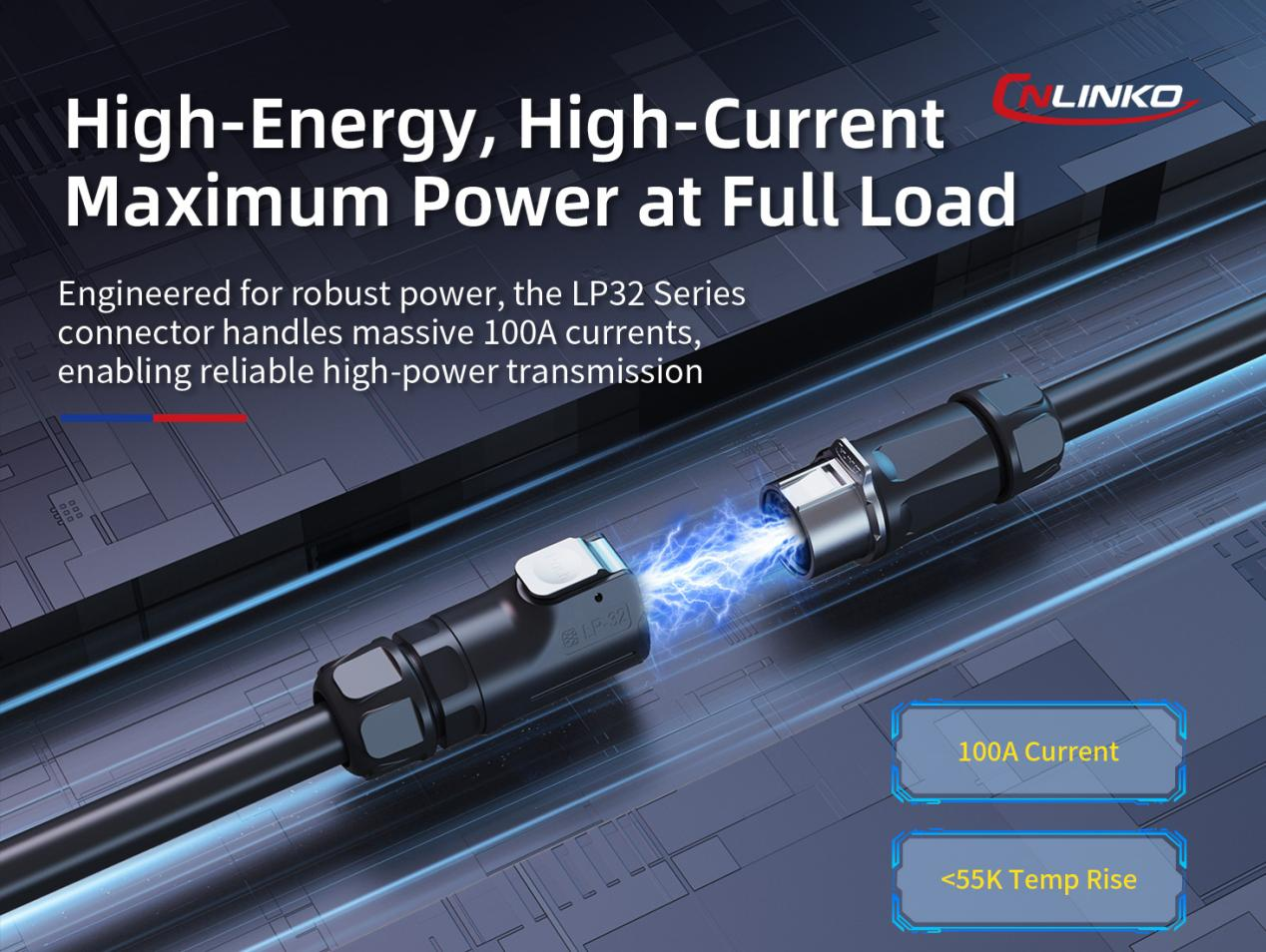
In terms of environmental and mechanical protection, the CNLINKO LP32 series high-current connectors excel. This series not only passes IP68/IPX9K dual waterproof tests but also features double-arm spring locks and a rear anti-backout structure, ensuring secure locking even under strong vibration. To address heat generation from high currents, the CNLINKO LP32 series maintains a temperature rise strictly within 55 K when running at full 100 A, and incorporates full-coverage touch-proof designs on both male and female ends, physically eliminating the risk of accidental electric shock.
In summary, selecting high-current connectors is a systematic engineering process involving electrical, environmental, and mechanical dimensions. Only by precisely controlling each parameter and combining them with industrial-grade solutions backed by deep technical expertise—such as those from CNLINKO—can stable operation under complex conditions be ensured, safeguarding overall system safety.