
















When selecting quick-connect waterproof industrial connectors, engineers often struggle with one question: "If it's fast to plug in, is it easy to come loose?" The answer is—not necessarily. It all depends on the locking mechanism. Quick-connect efficiency and anti-loosening performance are not inherently contradictory, but they require the right mechanical design to coexist. This article starts from the trade-off between efficiency and vibration resistance across three mainstream locking structures, helping you build a selection logic that delivers both speed and stability.
1. Three Mainstream Locking Structures: The Trade-Off Between Efficiency and Vibration Resistance
Different locking mechanisms for industrial-grade connectors have different strengths in insertion speed and vibration resistance:
- Push-Pull / Snap-Lock: One-hand operation, high efficiency; suitable for moderate vibration environments.
- Bayonet / Twist-Lock: One-hand operation, slightly less efficient than snap-lock; recommended for strong vibration environments.
- Dual-Lock: One-hand operation, two-step locking is still fast; recommended for high-frequency and strong vibration environments.
2. The Efficiency Dimension: How Much Time Can Quick-Connects Really Save?
The value of quick-connect connectors goes beyond "good feel"—it is backed by quantifiable data:
- Installation efficiency: Test data shows that batch installation with quick-connect connectors can save up to 75% of labor time.
- Insertion time: Traditional threaded connectors take significantly longer to install compared to quick-connect types.
- Maintenance speed: Snap-lock spring designs provide an audible click feedback, ensuring accurate mating even in blind-mate or low-light cabinet environments.
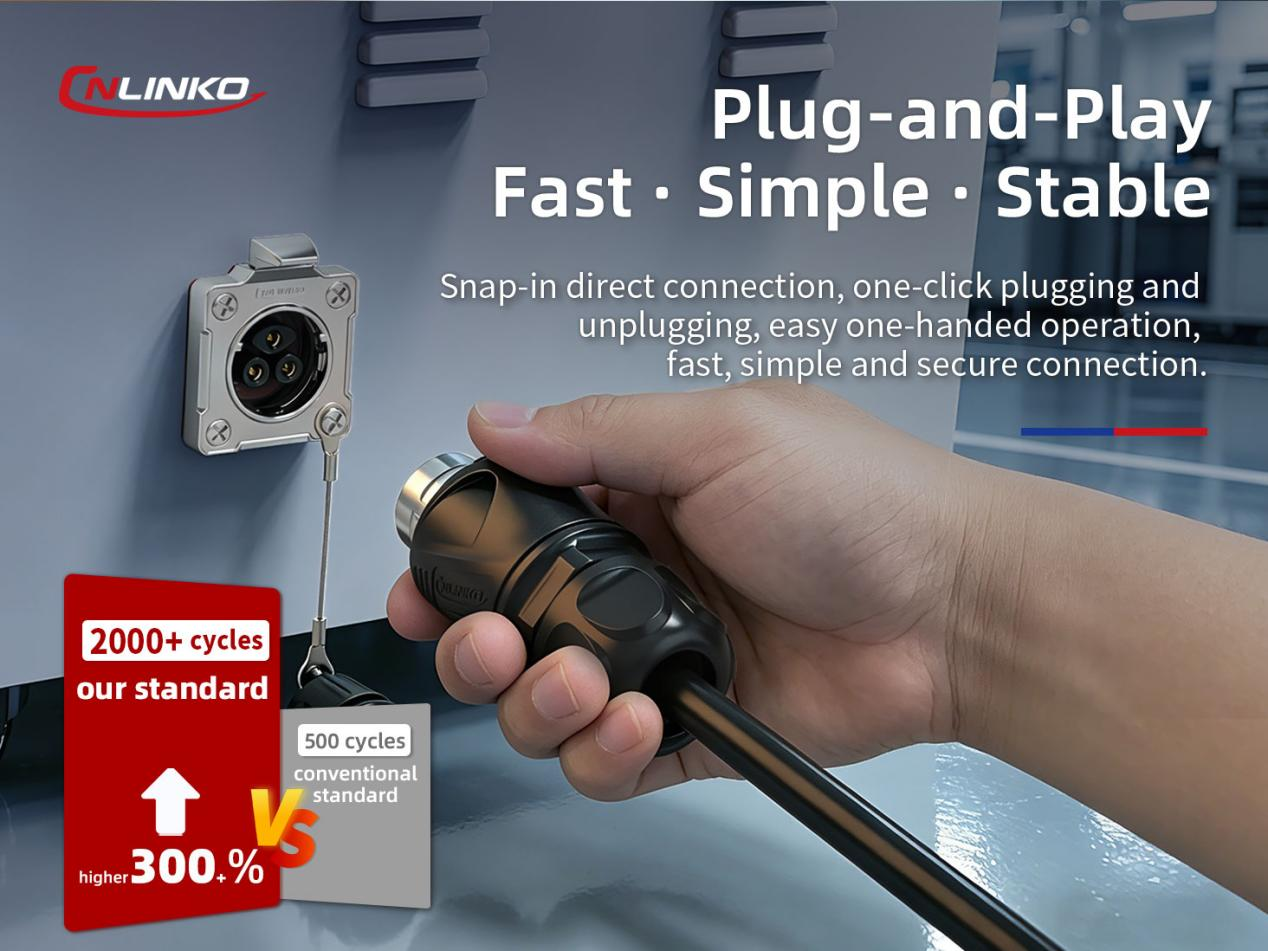
CNLINKO's LP Series waterproof industrial connectors feature a push-pull snap-lock design for one-hand operation. Their mating cycle life has been verified by UL/TÜV witnessed laboratories to exceed 2,000 cycles—four times the industry standard of 500 cycles. The series holds multiple patents, has won the German iF Design Award and Red Dot Award, and is certified to CQC, CE, TÜV, and UL standards, making it an ideal choice for rapid wiring and installation scenarios.
3. The Anti-Loosening Dimension: Three Hard Indicators to Verify
When selecting waterproof industrial connectors, don't just look at whether it "plugs in fast." You must verify these quantitative indicators:
① Retention Force Test
Push-pull self-locking connectors must be designed to prevent incorrect mating and must not loosen under specified pull force and duration.
② Vibration Test
It is recommended to check transient disconnection performance under conditions of 10–500 Hz and acceleration ≥5g. CNLINKO's DK24 Series waterproof industrial connectors adopt a dual-lock structure, achieving 0.10 μs zero transient interruption in vibration tests at 5–200 Hz and 5 mm amplitude, specifically designed for strong vibration scenarios.
③ Locking Force Retention
After 500 mating cycles, the locking force retention rate must be ≥80% to pass. Single snap-lock connectors may experience locking force degradation due to resonance under continuous vibration, while dual-lock structures use a secondary mechanical anti-disengagement pin to maintain extremely high separation force even under severe lateral pulling.
CNLINKO's DH Series waterproof industrial connectors feature a bayonet twist-lock design with an all-metal housing for high vibration and impact resistance. They have won the IDEA Award and are certified to CQC, CE, and TÜV standards. The DL Series high-current waterproof connectors adopt a "bayonet lock + anti-rotation collar" dual-lock system, supporting up to 50A high current, with a compact design nearly 50% smaller than traditional IEC 60309 plugs. They have won the iF Award, IDEA Award, and the 24th (2025) Shenzhen Enterprise Innovation Record, and are certified to TÜV, UL, and CE standards.
4. CNLINKO's Three Quick-Connect Industrial Waterproof Connector Selection Guide
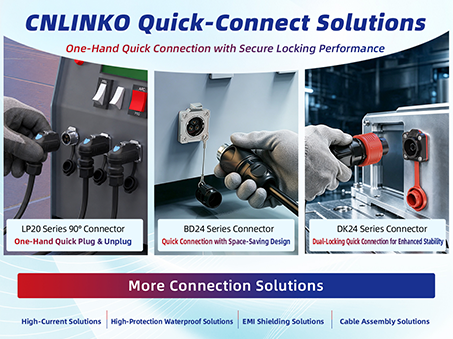
1. 90° Space-Saving Quick-Connect Solution (LP20 Series Industrial Connectors)
Designed for compact equipment and narrow installation spaces, balancing space utilization with connection stability.
- Snap-Lock Anti-Loosening: The plug end uses a snap-lock spring design that securely locks with the socket upon mating, effectively resisting normal vibration. This series holds multiple patents, has won the German iF Design Award and Red Dot Award, and is certified to CQC, CE, TÜV, and UL standards.
- One-Hand Easy Plug and Pull: The snap-lock operation logic supports one-hand quick insertion and removal, significantly reducing operator fatigue during maintenance.
- 90° Side Cable Exit: The cable exits laterally, saving vertical installation space while improving overall cable management aesthetics.
2. Panel-Level One-Hand Quick-Connect Solution (BD24 Series Industrial Connectors)
Focused on precision panel wiring scenarios, with minimalist operation and a flat appearance as core advantages.
- Snap-Lock Instant Engagement: The socket end adopts a snap-lock design, instantly locking upon plug insertion to eliminate poor contact. This series holds 4 domestic and 4 overseas invention patents, has won the German Red Dot Design Award and the 22nd (2023) Shenzhen Enterprise Innovation Record, and is certified to CQC, CE, UL, and TÜV standards.
- Press-to-Release Quick Disconnect: Supports quick insertion and press-to-release removal, offering simple and fast operation that significantly improves high-frequency debugging efficiency.
- Recessed Snap-Lock Design: The socket's snap-lock uses a recessed structure to minimize protrusion height, saving panel space and eliminating snagging risks.
3. Strong Vibration Dual-Lock Quick-Connect Solution (DK24 Series Industrial Connectors)
Built for demanding conditions such as strong vibration and high-frequency mating—a benchmark solution for "loosening anxiety."
- Dual-Lock for Maximum Stability: A dual-lock structure completely prevents accidental loosening caused by external forces or continuous vibration. This series holds 3 domestic invention patents and 2 utility model patents.
- Spring Contact Terminal for Stable Conductivity: High-elasticity spring contacts achieve gap self-compensation through elastic force, ensuring tight contact and stable current transmission without drift.
- Efficient One-Hand Operation: Despite achieving dual locking, this series still supports one-hand quick connection, balancing wiring efficiency with operational convenience.
5. Two Common Misconceptions
Misconception 1: Quick-connect connectors will inevitably come loose.
Wrong. Vibration resistance depends on the locking structure, not the insertion speed. For example, the DK Series dual-lock quick-connect waterproof connectors offer both high-speed mating and exceptional stability, making them an ideal choice for strong vibration environments.
Misconception 2: IP68 and IPX9K are interchangeable.
Wrong. IP68 evaluates sustained immersion capability (static pressure), while IPX9K evaluates resistance to high-temperature, high-pressure spray (dynamic pressure plus heat). The physical stresses tested are completely different. For applications requiring both immersion and spray resistance, choose products rated for both IP68 and IPX9K.
Conclusion
Selecting quick-connect waterproof industrial connectors comes down to two things: efficiency depends on the locking structure type (snap-lock / bayonet / dual-lock), and anti-loosening reliability depends on quantitative test data (retention force, vibration transient performance, locking force decay). Both dimensions must be verified together. A quality product should meet standards across locking structure, mating cycle life, and ingress protection simultaneously.
Understanding how to balance efficiency and anti-loosening allows engineers to both calculate the "time savings" and hold the line on "reliability" when making their selections.