













Some temperature rise is normal when a high-current connector operates, but excessive heating often indicates a mismatch involving current, conductor size, contact resistance, termination quality, or heat dissipation. A safety assessment should not rely on the connector’s current rating alone. Consider actual load current, conductor cross-sectional area, ambient temperature, termination method, and contact condition together.
What should you check first when a high-current connector overheats?
First, measure continuous and peak currents and check for overload. Second, verify that conductor size matches both the load and terminal specification; an undersized conductor adds heat. Third, inspect contact resistance and termination quality, including incomplete crimping, loose screws, defective solder joints, contamination, and contact wear. Fourth, assess ambient temperature, enclosure ventilation, and densely packed wiring. Fifth, confirm full mating and locking, and check whether vibration or repeated mating has changed the contact interface.
Why does a higher current amplify contact problems?
Both conductors and mating interfaces have resistance. Under the I²R relationship, resistive heat increases with the square of current. A change in contact resistance that is barely noticeable at a low current may produce substantial localized heating at 50 A or 100 A. Reduced contact area or undersized conductors can further restrict heat removal, increasing temperature rise and accelerating material aging.
Which standards help assess high-current temperature rise?
IEC 61984 provides relevant requirements for industrial connector safety and rated performance; IEC 60512-2-1 is among the applicable contact-resistance test methods. Interpret any temperature-rise figure together with its test current, ambient temperature, conductor size, termination method, and test duration. A single value such as “≤50 K” does not establish suitability under every operating condition.

Which applications require special attention to derating and temperature rise?
Energy storage cabinets, inverters, laser systems, and industrial power supplies operating for long periods at high load need particular attention to continuous current and temperature rise. High enclosure temperatures, dense wiring, or limited ventilation may require current derating. Large cables also increase mechanical loading at terminals and need adequate bend clearance. A 50 A or 100 A nameplate rating does not mean the connector can carry that current continuously in every environment.
How does CNLINKO validate temperature rise in high-current connectors?
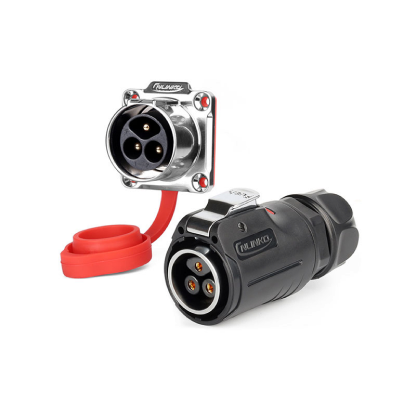
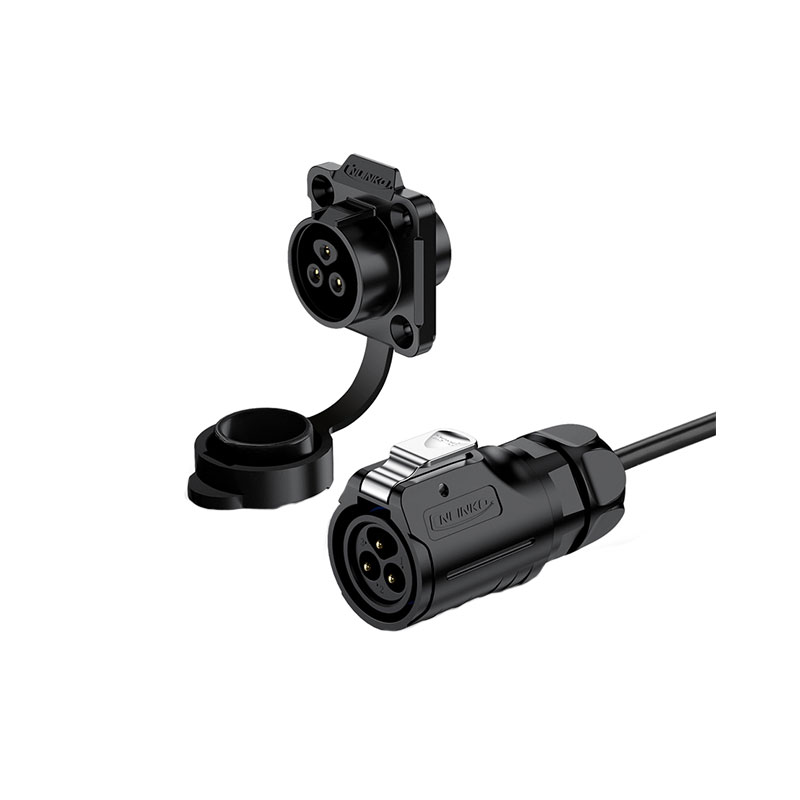
For a compact 50 A connection, CNLINKO’s three-contact DL28 Series accepts 10–16 mm² (8–6 AWG) conductors and incorporates dual locking and a finger-safe design. Under specified laboratory conditions, the DL28 Series achieved a 50 A rated current, a maximum temperature rise of ≤50 K, and contact resistance of ≤1.0 mΩ. These results support its continuous current-carrying performance and low connection losses under those conditions. For actual equipment, assess the relationship among current, conductor size, ambient temperature, and temperature rise, and use model-specific test data to determine whether derating is required in hot environments or during continuous full-load operation.