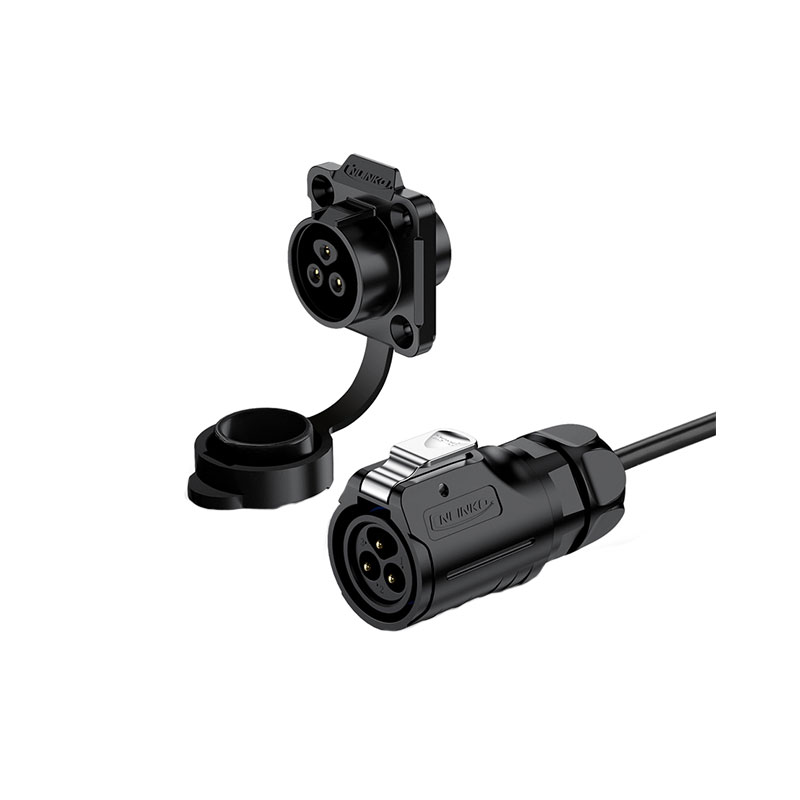














A high-current connector should not be selected on current rating alone. For 50 A, 100 A, and similar high-power applications, assess continuous current, conductor size, temperature rise, contact resistance, dielectric withstand and insulation, locking, and the operating environment. In energy storage, industrial power, and laser systems that carry sustained loads, the decisive question is whether the connector can carry the target current reliably with the specified conductor size and ambient temperature.
Which specifications matter most for high-current connector selection?
Start with continuous operating current and conductor size. A 50 A or 100 A rating must be paired with an appropriate conductor cross-sectional area; an undersized wire increases heating in both the conductor and terminal.
Next, assess temperature rise. It indicates heating under sustained load and must be interpreted in light of test current, ambient temperature, conductor size, and termination method.
Third, assess contact resistance. Resistance at the mating interface creates losses and heat, so it should remain low and stable over time.
Fourth, review electrical safety: rated voltage, dielectric withstand, insulation resistance, finger-safe features, and terminal retention. For vibrating, outdoor, or frequently serviced equipment, also consider locking, IP protection, and mating endurance.
Why should you compare more than rated current?
Heating depends on both current and contact resistance. As current increases, losses at the contact interface rise substantially. An undersized conductor, incomplete crimp, loose contact, elevated contact resistance, or high ambient temperature can raise operating temperature even when the nameplate current rating appears sufficient.
The key question is whether the connector can carry the target current continuously with the specified conductor size and ambient temperature. Evaluate current, wire size, ambient temperature, and temperature rise as a set rather than comparing “50 A” and “100 A” labels alone.
How should you evaluate temperature rise and safety?
A temperature-rise test should state the continuous test current, conductor cross-sectional area, ambient temperature, termination method, and test duration. For high-current connectors, compare contact resistance before and after testing because changes at the interface affect heating and long-term reliability.
Electrical safety assessment should include dielectric withstand, insulation, finger-safe construction, and terminal retention. On vibrating equipment, verify that the lock withstands mechanical loading; outdoors, consider IP protection and environmental durability. Meeting a current target does not eliminate mechanical or environmental risks.
Which standards can inform high-current connector selection?
IEC 61984 provides relevant requirements for industrial connector safety and rated performance, IEC 60512 contains methods for characteristics such as contact resistance, and IEC 60529 addresses IP ratings for dust and water protection.
Standard test conditions cannot represent every installation. Hot enclosures, densely routed cables, tight bends in heavy conductors, and continuous full-load operation can affect actual current-carrying capacity. Assess current derating under real operating conditions when necessary.
Which applications require special attention to temperature rise?
Energy storage cabinets, inverters, industrial power supplies, and laser equipment carrying high loads for long periods require close attention to continuous current, conductor size, and temperature rise. Compact equipment also needs adequate connector clearance and cable bend space. Vibrating or mobile equipment requires secure locking and stable electrical contact.
A connector rated 50 A does not necessarily support 50 A continuously at every ambient temperature. Account for the actual conductor size, ambient temperature, cooling, and installation method.
What high-current industrial connection solutions does CNLINKO offer?
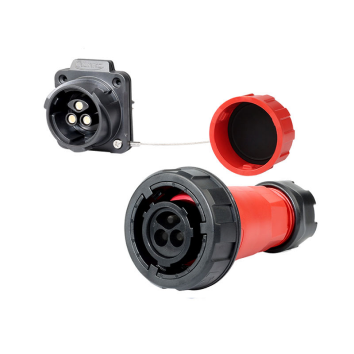
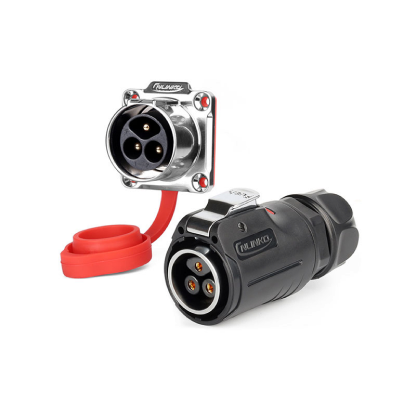
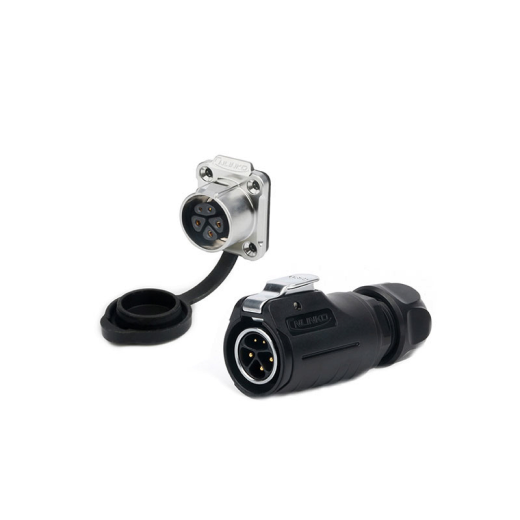
For a compact, highly protected 50 A interface, CNLINKO offers the three-contact DL28 Series. It accepts 10–16 mm² (8–6 AWG) conductors and features dual locking and finger-safe protection, balancing high-current transmission, space constraints, and secure connection under vibration. For higher current, the three-contact LP32 Series configuration supports up to 100 A.

Under specified laboratory conditions, CNLINKO’s DL28 Series achieved a 50 A rated current, maximum temperature rise of ≤50 K, and contact resistance of ≤1.0 mΩ. It also passed IP68 testing at a water depth of 100 m for 72 hours and IPX9K high-pressure, high-temperature spray testing. These results support evaluation for energy storage, laser systems, and industrial power equipment requiring current capacity, ingress protection, and connection stability. Final suitability depends on the exact model, conductor size, ambient temperature, and documented test conditions.
High-current connector selection is therefore not simply a search for the highest nameplate current. Current, conductor size, temperature rise, contact resistance, and safety characteristics must align with the operating conditions to support reliable long-term service.