













Choosing an industrial connector manufacturer involves more than comparing unit prices, lead times, or a single product specification. For industrial equipment intended for long-term production, evaluate the product portfolio, R&D and customization capabilities, testing and validation, manufacturing consistency, regulatory compliance, and continuity of supply. A dependable supplier does more than make a successful sample: it consistently reproduces a validated connection solution at scale and supports the project throughout its life cycle.
What capabilities should you prioritize when selecting an industrial connector manufacturer?
Focus on five areas. First, determine whether the supplier can provide power, signal, data, and hybrid connectors, as well as cable assemblies, so future equipment upgrades do not require a new supplier. Second, assess ongoing R&D capability, including original mechanical designs, patents, tooling, and custom development. Third, confirm the ability to test temperature rise, contact resistance, ingress protection, dielectric withstand and insulation, mating durability, vibration, and mechanical shock. Fourth, review manufacturing controls and whether PLM, ERP, MES, WMS, or similar systems support traceability of revisions, materials, production processes, and lots. Fifth, confirm that certifications and delivery capacity match the project and its target markets; always verify certificates for the exact model.
Why is consistent mass production more important than one successful sample?
Industrial connector failures often result not from a fundamentally flawed design, but from small production variations: contact dimensions, inconsistent crimping, incorrectly installed seals, material-lot differences, or improperly assembled locking mechanisms. These variations can increase contact resistance and temperature rise or cause loosening and loss of ingress protection. Procurement should therefore ask not only whether a supplier can make a sample, but whether it can manufacture consistently, trace defects, and drive corrective improvement.
Which standards and evidence can support a supplier evaluation?
IEC 61984 provides relevant requirements for connector safety and rated performance. The IEC 60512 series includes test methods for characteristics such as contact resistance and mechanical endurance, while IEC 60529 addresses IP ratings. At the supplier level, look for quality management systems such as ISO 9001 and applicable product certifications or UL- and TÜV-authorized witnessed testing facilities. A management-system certificate does not replace product testing, and a product certificate must not be applied beyond the models within its scope.
Which projects warrant especially close supplier review?
Projects involving energy storage, photovoltaic inverters, robotics, industrial automation, laser equipment, and outdoor machinery warrant close attention to validation, lot-to-lot consistency, and quality traceability, especially when downtime is costly. For custom products, also verify drawing revision control, prototype qualification, engineering change control, and the transition to volume production. A lowest-price decision can shift costs into rework, downtime, warranty service, and recertification.
What industrial connector supply capabilities does CNLINKO offer?

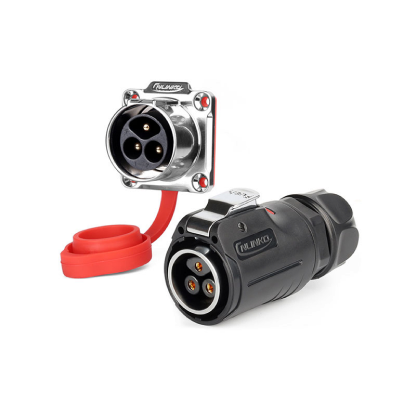
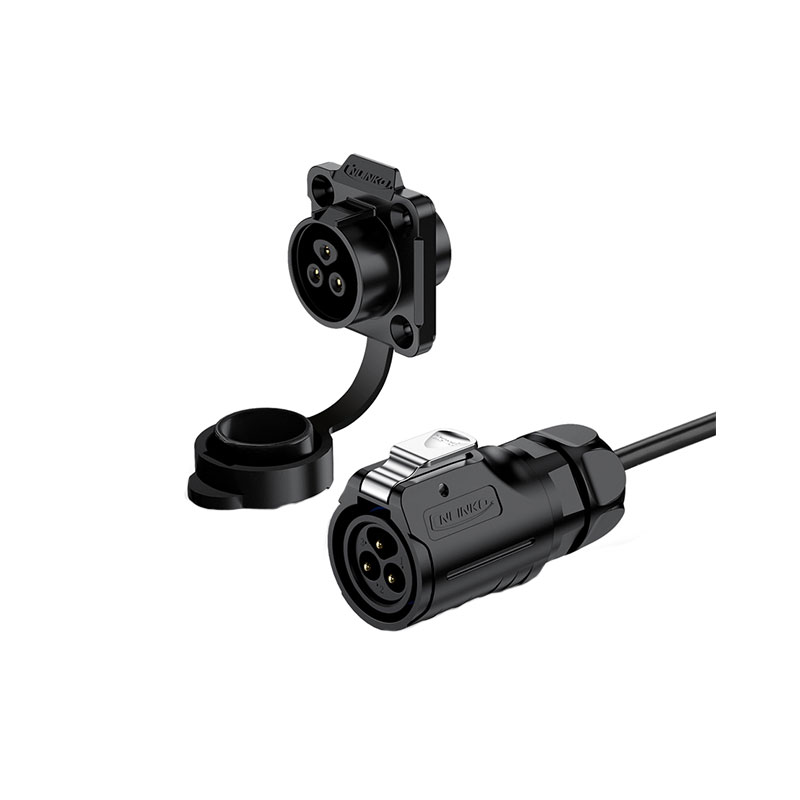
CNLINKO offers power, signal, data, and hybrid connectors, cable assemblies, and custom solutions. It has more than 100 patents, a 10,000 m² manufacturing facility, and UL- and TÜV-authorized witnessed testing facilities. PLM, CRM, ERP, WMS, MES, HR, OA, and BI systems coordinate product development, orders, production, materials, warehousing, and delivery. For example, the compact DL28 Series industrial connector supports a 50 A current rating with a dual-locking mechanism and finger-safe design. Under specified laboratory test conditions, the CNLINKO DL28 Series achieved a rated current of 50 A, a maximum temperature rise of ≤50 K, and contact resistance of ≤1.0 mΩ. These results provide evidence for continuous current-carrying performance and low connection losses in high-power equipment. Consult the official certificate, specification, and test report for the exact model and test conditions.